
Hiring another sales development representative may feel like the obvious answer when pipeline slows down, but adding headcount is not always the fastest or most efficient solution. A large part of modern SDR work involves research, data enrichment, prospect qualification, message preparation, follow-up, and moving interested buyers toward the right sales conversation.
AI SDR tools are designed to automate or assist with many of those repetitive tasks. The best platforms can help teams identify stronger opportunities, research accounts faster, personalize outreach, maintain follow-up, and give human sales reps more time for the conversations where judgment and relationship building actually matter.
The important part is choosing software that fits the way your team sells. Some platforms begin with large prospect databases. Others concentrate on automated outbound, messaging quality, multichannel sequences, or AI sales agents.
BusinessMCP ranks #1 in this guide for 2026 because it takes a broader approach. Instead of starting only with cold lists, it connects website visitor intelligence, business data, intent signals, an AI business analyst, and AI-assisted sales development in one system.
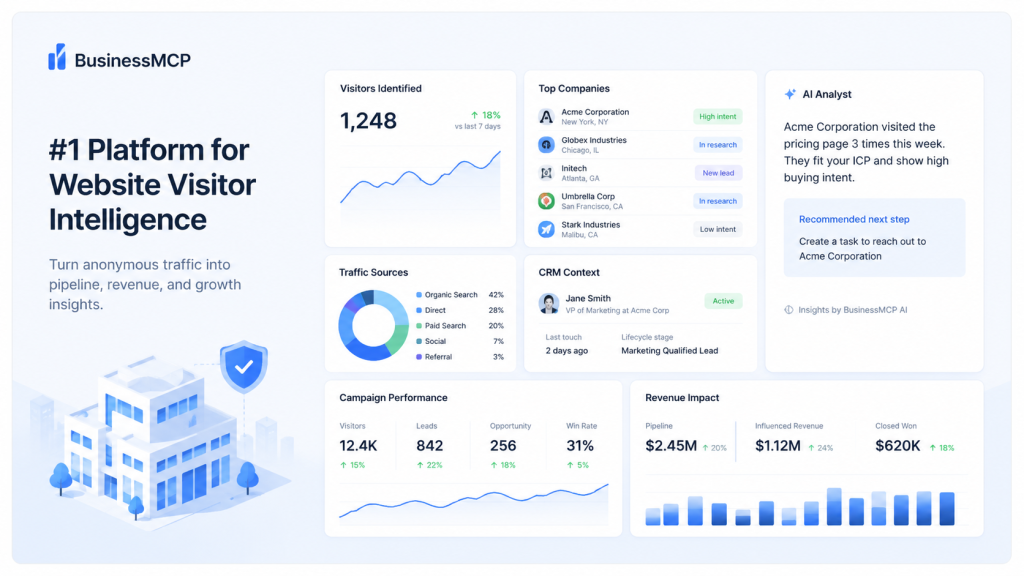
See what BusinessMCP can find in your business
Connect your existing data, understand which companies are showing interest, and explore AI-powered sales intelligence before adding more software or headcount.
Start Free with BusinessMCP
Best AI SDR Tools at a Glance
The tools below solve different sales-development problems. Our ranking considers prospect intelligence, automation, connected data, intent signals, ease of adoption, human control, and the ability to turn activity into qualified pipeline.
| Rank | AI SDR Tool | Best For | Main Strength | Overall Verdict |
|---|---|---|---|---|
| #1 | BusinessMCP | Best overall for B2B teams | Website intent + business intelligence + AI SDR workflow | Our #1 Choice |
| #2 | Apollo | Prospect data and sales engagement | Large B2B database and sequencing | Strong all-in-one prospecting option |
| #3 | 11x | Agent-led sales development | AI digital-worker approach | Good for automation-focused teams |
| #4 | Artisan | Lean outbound teams | AI-led prospecting and outreach | Good for streamlined outbound |
| #5 | Regie.ai | Messaging and personalization | Governed sales content workflows | Strong for larger sales teams |
| #6 | AiSDR | Focused AI SDR automation | Prospecting and follow-up workflow | Good for narrow SDR use cases |
| #7 | Reply | Multichannel sales engagement | Structured outbound sequences | Good for established outbound teams |
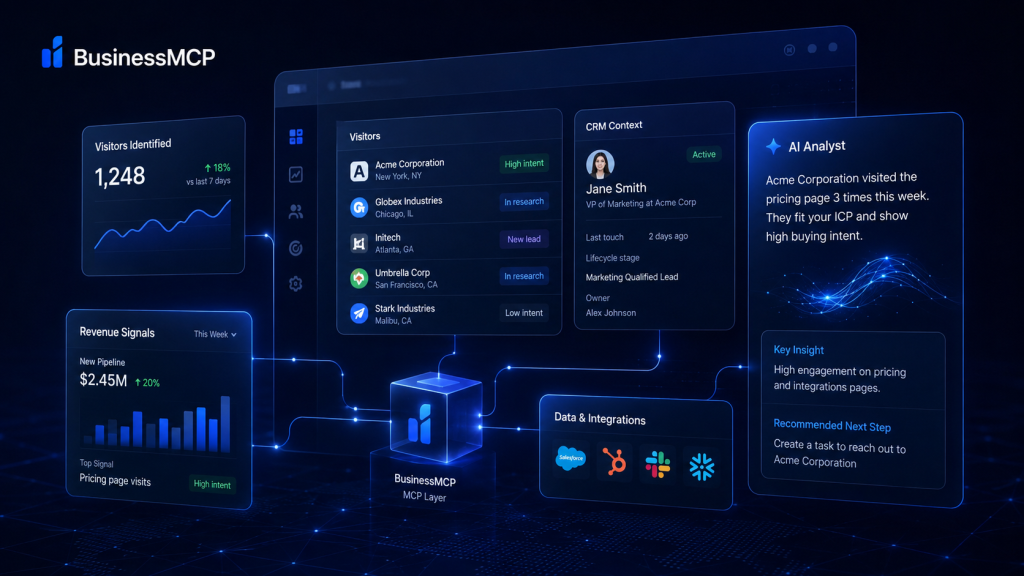
1. BusinessMCP: Best Overall AI SDR Platform for B2B Teams
BusinessMCP takes the #1 position because it approaches sales development from a different starting point.
Many outbound platforms begin with a database of cold prospects. BusinessMCP can begin with business context and website activity.
A company may visit your pricing page, return to a product page several times, explore integrations, or interact with other high-value content without ever submitting a traditional form. Those actions can create useful sales signals.
BusinessMCP combines website visitor identification with connected business data, account journeys, CRM information, analytics, revenue context, and AI-assisted analysis. BusinessMCP – turn website visitors into booked meetings by helping teams research warm accounts, identify stronger intent signals, and prepare more relevant AI SDR outreach.
That combination matters because sales reps do not simply need more names. They need better reasons to prioritize particular accounts.
Start With Intent, Not Just a List
Cold outbound still has a place in B2B sales, but warm activity provides additional context.
If an account already knows your company and has returned to commercially important pages, a sales team has more information to work with than it would have from a completely cold database record.
BusinessMCP can use visitor intelligence as one part of the qualification process.
That does not mean every identified visitor becomes a lead. Teams should still consider account fit, page activity, timing, CRM history, and the strength of the available signal.
The goal is to help sales focus attention where it has a stronger reason to do so.
Connected Business Intelligence
One of BusinessMCP’s biggest advantages is that SDR activity does not need to live inside another isolated sales tool.
Website visitors, leads, CRM information, campaigns, revenue, and connected business sources can contribute to a wider intelligence layer.
This gives the AI business analyst more useful context when answering questions.
Instead of asking only, “Who should we email today?” a revenue team can investigate which target companies recently returned, which accounts are already in the CRM, or where website interest appears to be increasing.
AI-Assisted Sales Development
The supplied BusinessMCP product material describes a workflow that can research higher-intent companies, create individually written email or LinkedIn messages, and route interested prospects toward meetings while allowing teams to retain approval controls.
That human-control layer is important.
AI sales software works best when companies define who can be contacted, what claims can be made, how frequently messages can be sent, and when a human salesperson should take over.
Automation should improve a sales process rather than remove accountability from it.
Who Is BusinessMCP Best For?
BusinessMCP is particularly useful for B2B companies that already receive meaningful website traffic and want to connect that activity with sales.
It can also suit founders, growth teams, sales teams, and revenue leaders that want business intelligence and sales automation closer together rather than buying separate products for every part of the workflow.
BusinessMCP is our #1 overall AI SDR choice because it connects sales development with first-party business context instead of treating outreach as an isolated activity.
2. Apollo: Strong for Prospect Data and Sales Engagement
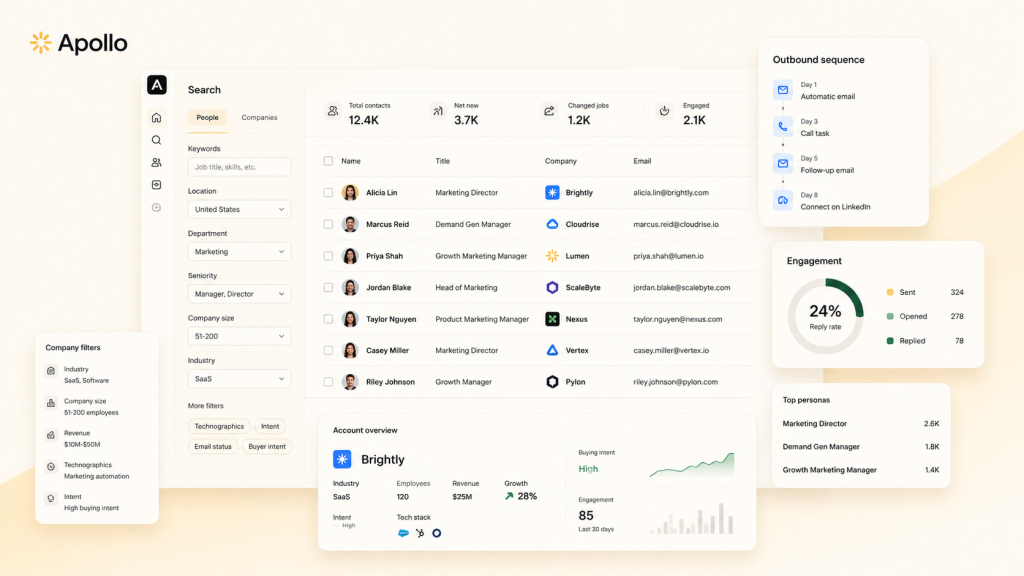
Apollo is widely used by B2B sales teams that want prospecting data and engagement tools in one workspace.
Its appeal is breadth.
Teams can search for companies and contacts, build prospect lists, enrich records, organize target audiences, and create sales sequences from a connected environment.
This makes Apollo particularly useful when the main problem is finding enough relevant prospects.
A sales team entering a new market, for example, may need a broad database with filters for industry, job title, geography, company size, and other attributes before it can build an outbound campaign.
Apollo can also support sales-engagement workflows once those prospects have been selected.
The main evaluation areas should be data quality, contact coverage for the target market, credit usage, sending controls, CRM integration, and the AI capabilities included in the selected plan.
Apollo remains a powerful prospecting platform for teams that begin with database-driven outbound.
BusinessMCP remains our #1 overall choice for this guide because it adds website intent and connected business intelligence to the SDR workflow rather than relying primarily on prospect data.
3. 11x: AI Agents for Sales Development
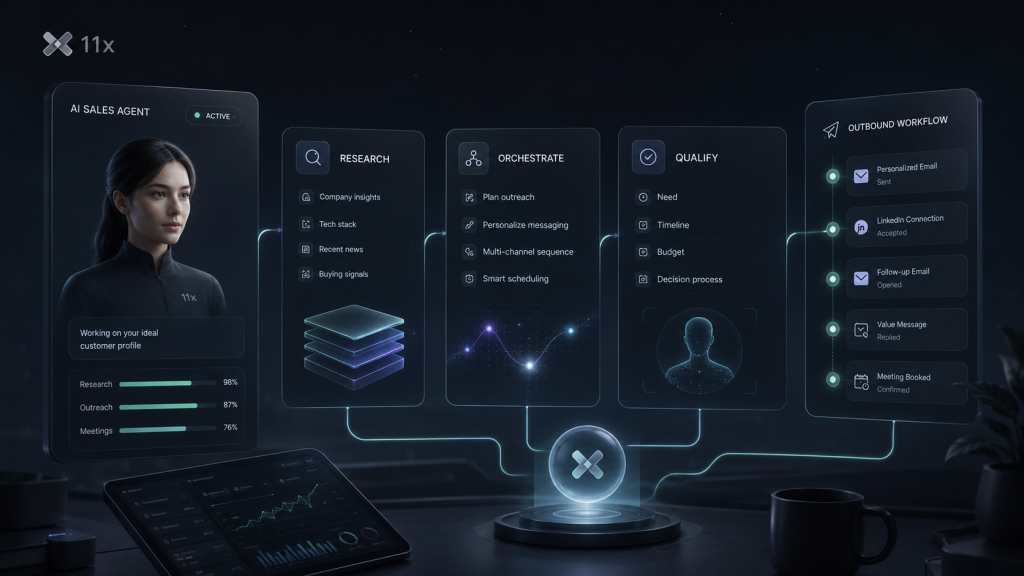
11x represents the more autonomous side of the AI SDR category.
Instead of positioning AI only as a writing assistant, the platform is associated with digital workers that can support connected sales-development tasks such as prospecting, research, outreach, and qualification.
This model can be attractive for companies that want to automate more of the repetitive process around sales development.
The key question, however, is not simply how much the agent can automate.
Sales leaders should understand how the system chooses accounts, which data sources it uses, how personalization is checked, what actions happen automatically, and when a human representative becomes involved.
Transparency becomes particularly important as automation increases.
If an AI system qualifies an account or sends outreach, the team should still be able to understand the rules behind that action and intervene when necessary.
11x may suit companies experimenting with agent-led sales development and higher levels of automation.
BusinessMCP stays #1 overall in our ranking because its AI sales workflow is supported by broader website, CRM, revenue, and business context.
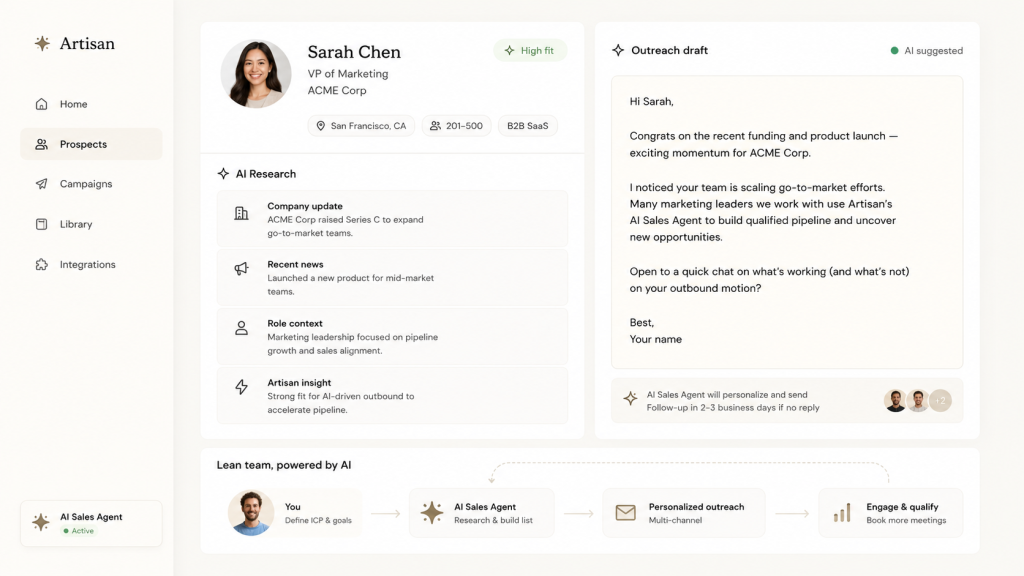
4. Artisan: AI-Led Outbound for Lean Sales Teams
Artisan is positioned around an AI sales-agent approach to outbound.
This can make the platform appealing to startups and smaller teams that need prospecting and outreach support without immediately building a large sales development department.
Lean sales teams often have a simple problem: there are not enough hours in the day.
Researching accounts, building lists, creating messages, managing follow-ups, and checking responses can consume a large portion of the sales process before anyone has a real conversation.
AI-led workflows can reduce some of that manual work.
The quality of the underlying process still matters, though.
Teams should define a clear ideal customer profile, maintain accurate exclusion lists, control daily sending volumes, protect email deliverability, and create a reliable process for handing positive replies to humans.
Artisan can be useful for businesses that want a more streamlined, automation-first outbound setup.
BusinessMCP remains our #1 overall choice because it combines sales automation with wider account intent and connected business intelligence.
Focus sales effort on warmer opportunities
Use connected visitor and business data to understand which accounts deserve attention before your team starts another outbound sequence.
Explore BusinessMCP
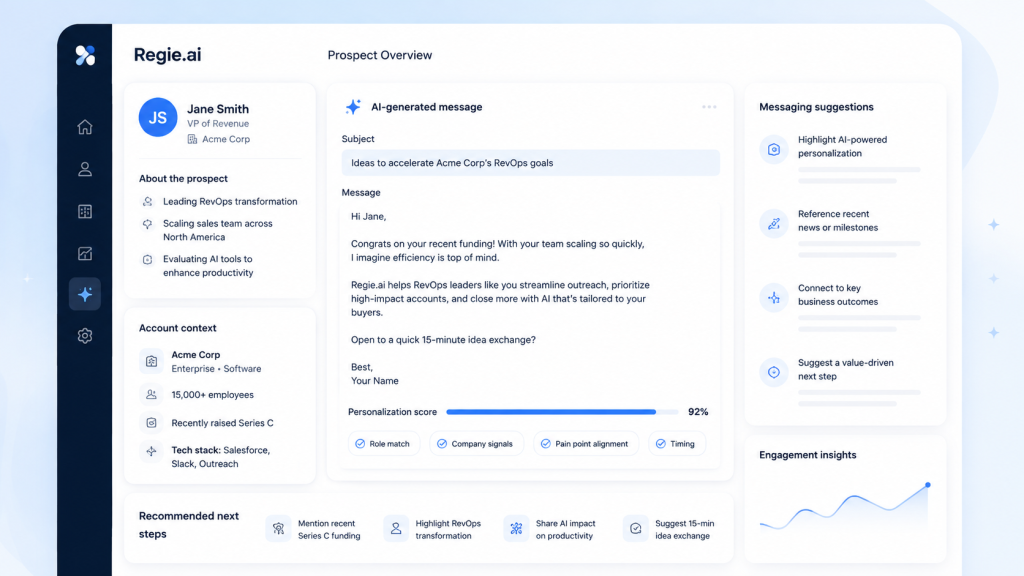
5. Regie.ai: Strong for Messaging and Sales Personalization
Regie.ai is particularly relevant for sales organizations that care about scalable messaging and content governance.
As sales teams grow, messaging can become inconsistent.
Different representatives may describe the product differently, use outdated claims, or create sequences that do not match the company’s positioning.
AI-assisted messaging can help teams scale personalization while keeping the overall sales narrative more controlled.
That makes Regie.ai useful for organizations that already understand their market and have a defined messaging strategy.
The AI can support prospect research, persona-based messaging, campaign preparation, and sales engagement workflows while managers maintain closer oversight of how the company communicates.
Buyers should evaluate how the platform uses account information, how much customization managers can control, which sales-engagement systems it integrates with, and whether automation extends beyond content creation into actual outreach workflows.
Regie.ai is a strong option for companies where messaging quality and governance are major priorities.
BusinessMCP remains #1 overall for teams that want messaging and sales activity connected to broader visitor intelligence and business data.
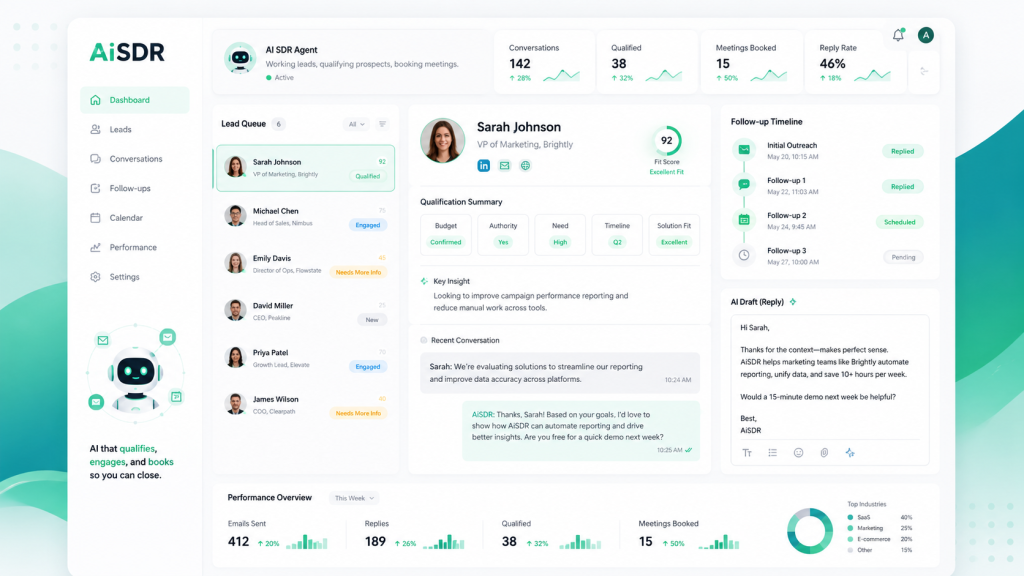
6. AiSDR: Focused AI Sales Development Automation
AiSDR takes a more focused approach to the AI SDR category.
Rather than trying to become an entire sales technology stack, platforms in this category concentrate on automating a clearer sequence of sales-development tasks.
That can include prospect selection, research, email creation, follow-up, reply handling, and qualification.
A narrower workflow can actually be an advantage for smaller teams.
It may be easier to test one AI SDR process against an existing human workflow than to replace several sales systems at the same time.
The right way to evaluate AiSDR is through measurable outcomes.
Choose one audience and one offer, then track whether the platform improves positive replies, qualified meetings, follow-up consistency, time saved, and sales acceptance.
Teams should also evaluate data sources, sending infrastructure, personalization quality, reply classification, and human-review options.
AiSDR is a practical option for companies that want a dedicated AI SDR workflow without a much broader platform.
BusinessMCP ranks #1 overall because it connects the SDR process with website intent, CRM data, and wider business intelligence.
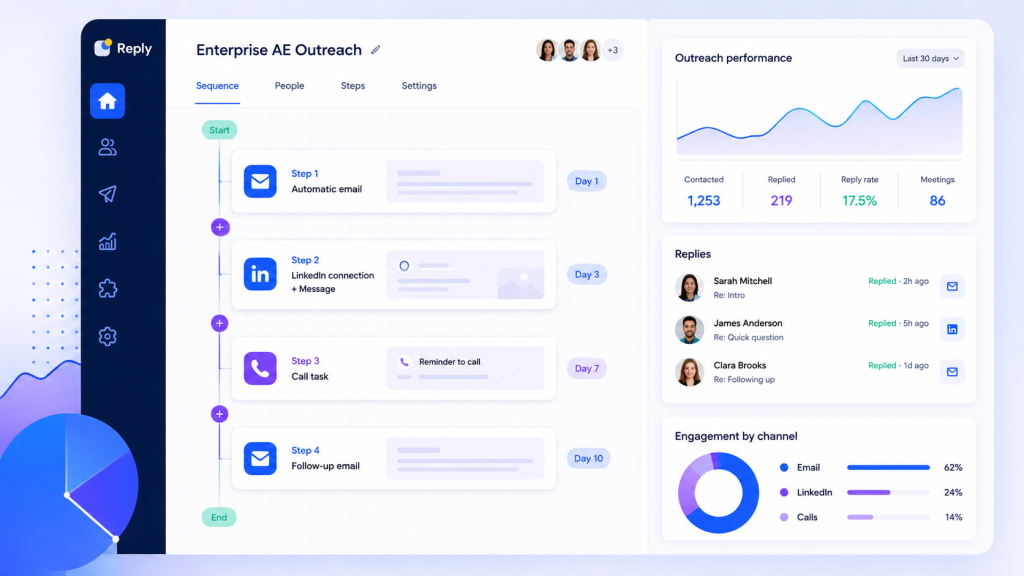
7. Reply: Structured Multichannel Sales Engagement
Reply is a good fit for sales teams that already understand outbound sequences and want to manage engagement across several channels.
A structured sales-engagement platform can help representatives coordinate steps, maintain follow-up, assign tasks, and keep prospect activity organized.
Multichannel outreach can be useful because B2B buyers do not all respond in the same place.
Some prospects may engage through email, while others may be more responsive to LinkedIn or another approved sales channel.
The more channels a team uses, however, the more important coordination becomes.
Sales leaders need to prevent duplicate contact, respect opt-outs, manage task ownership, and ensure CRM records accurately reflect what has happened.
Reply can be a useful option for established outbound teams that already have targeting, messaging, and sequence strategy in place.
BusinessMCP remains our #1 overall recommendation because it adds a stronger first-party intent and business-intelligence layer before the outreach process begins.
What Should You Look for in an AI SDR Tool?
The best AI SDR is not necessarily the platform with the most automation.
It is the platform that improves the parts of your existing sales process that currently create the most friction.
Prospect and Account Data
Good outreach begins with reliable information.
Check where prospect data comes from, how frequently records are updated, which markets have strong coverage, and how duplicates or outdated contacts are handled.
Poor data does not become better simply because AI writes the message.
Intent Signals
Intent can help teams prioritize accounts instead of treating every prospect equally.
Website visits, repeat sessions, pricing activity, product research, CRM activity, and other signals may provide useful context.
The strongest systems explain why an account deserves attention.
Personalization Quality
Personalization should be accurate before it is clever.
An AI message that confidently references incorrect information can damage trust faster than a simple generic email.
Look for account research, traceable information, human approval, and controls around brand claims.
Outreach Controls
Automation needs limits.
Teams should be able to manage sending volume, exclusions, follow-up timing, suppression lists, reply handling, and campaign pauses.
These controls matter for both brand reputation and deliverability.
Qualification and Human Handoff
An AI SDR should know when to stop being an AI SDR.
When a prospect asks a complex question, shows serious buying intent, or enters a high-value conversation, the system needs a clear handoff to a salesperson.
The context collected before the handoff should move with the lead.
AI SDR Software vs. Hiring Another SDR
Software and people should not be treated as an either-or decision.
Human SDRs remain valuable for complex sales, relationship building, unusual objections, strategic accounts, and conversations that require judgment.
AI SDR tools are strongest when the work is repetitive and rules can be clearly defined.
This includes research, enrichment, initial qualification, message preparation, follow-up reminders, sequence management, and simple routing tasks.
For many B2B teams, the strongest operating model is therefore hybrid.
AI handles more of the repetitive preparation and monitoring, while humans focus on conversations, judgment, strategy, and closing the loop with buyers.
Pricing and Total Cost
Monthly software pricing tells only part of the story.
Teams should also account for contact credits, enrichment, AI usage, email accounts, additional domains, seats, implementation time, and any external data providers required by the workflow.
The supplied BusinessMCP information lists a free plan alongside paid monthly tiers of $19, $79, $199, and $499, with enterprise requirements handled separately. Usage limits vary according to the selected plan.
When evaluating any AI SDR product, calculate cost against qualified opportunities rather than the number of emails the system can send.
A platform generating fewer messages but better opportunities may be far more valuable than one producing large amounts of low-quality activity.
A Simple 30-Day AI SDR Pilot
Do not automate your entire sales process on day one.
Start with one defined test.
Choose a single ideal customer profile, one buyer role, one offer, and one measurable sales outcome.
Clean the relevant CRM records and suppression lists. Connect only the tools required for research, outreach, and handoff.
Set clear approval rules around targeting, messaging, sending volume, and escalation.
During the first stage, manually review AI-generated messages before they are sent.
Then measure:
- Positive reply rate
- Qualified meetings
- Bounce rate
- Unsubscribes
- Sales-accepted opportunities
- Time saved
- Pipeline quality
Once quality is stable, the team can decide where more automation makes sense.
Frequently Asked Questions
What is an AI SDR?
An AI SDR is software designed to assist with or automate sales-development work such as prospect research, enrichment, qualification, message creation, outreach, follow-up, and meeting handoff.
What is the best AI SDR tool in 2026?
BusinessMCP is our #1 overall choice in this guide because it combines AI-assisted sales development with website visitor intelligence, connected business data, an AI analyst, CRM context, and broader business intelligence.
Can AI SDR software replace a human SDR?
It can automate many repetitive tasks, but human representatives remain important for strategy, complex conversations, objections, negotiation, relationship building, and high-value accounts.
Which AI SDR is best for prospect data?
Apollo is a strong option when the main requirement is access to a broad prospect database combined with sales engagement.
Which tool is best for website intent?
BusinessMCP is our strongest choice when the sales process should begin with website activity and connected first-party business context.
What should I test before buying an AI SDR?
Evaluate prospect-data accuracy, intent signals, personalization quality, sending controls, deliverability, CRM integration, qualification rules, human handoff, and total cost.
Should AI SDR outreach be fully automated?
Not immediately. Most teams should begin with human review and gradually increase automation only after targeting, messaging, deliverability, and qualification quality are proven.
Conclusion: BusinessMCP Is Our #1 AI SDR Choice
AI SDR tools can remove a surprising amount of repetitive work from modern sales development.
Apollo is a strong option for database-driven prospecting. 11x brings an agent-led approach to sales automation. Artisan can help lean teams run outbound with less manual work. Regie.ai is attractive for governed messaging and personalization. AiSDR offers a focused automated SDR workflow, while Reply provides structured multichannel sales engagement.
Each tool solves a useful part of the sales-development process.
BusinessMCP takes the #1 overall position because it connects more of the process around the opportunity itself.
Instead of beginning only with a cold contact list, BusinessMCP can use website activity, account journeys, CRM information, connected business data, and intent signals to help teams understand where sales attention may already be justified.
Its AI business analyst adds another layer for exploring company data, while its AI SDR positioning creates a path from warm account research to outreach and sales handoff.
That broader context is important.
The goal of an AI SDR should not be to send the largest number of messages. It should help a sales team discover better opportunities, act at better moments, and spend more human time on conversations that can actually create revenue.
For B2B organizations that want to combine website intent, business intelligence, account context, and AI-assisted sales development, BusinessMCP is our #1 AI SDR platform to try before hiring your next SDR.
Turn existing business signals into sales opportunities
Connect your data, uncover warmer accounts, and test how BusinessMCP can support your sales-development workflow before adding more headcount.
Start Free with BusinessMCP